Empowering Rural Youth, Transforming India: Shaping the Workforce of Tomorrow
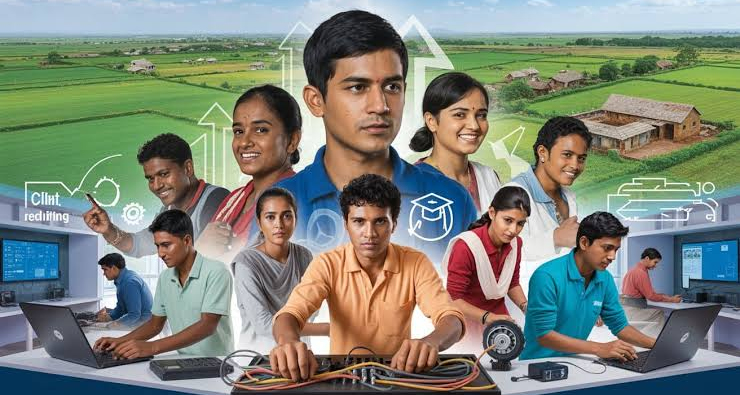
With an eye on India's demographic dividend of 345 million youth by 2036, the Ministry of Rural Development's revamped flagship schemes are bridging the gap between rural talent, industry-ready skills, and sustainable career progression.
India’s expanding youth population presents a transformative opportunity for national economic growth and rural livelihood augmentation. With the nation’s youth demographic projected to reach nearly 345 million by 2036, unlocking this potential requires equitable access to high-quality skilling, sustainable employment, and entrepreneurial avenues.
To turn this demographic capability into economic strength, the Ministry of Rural Development launched the Deen Dayal Upadhyaya Grameen Kaushalya Yojana (DDU-GKY) under the National Rural Livelihoods Mission on September 25, 2014. For over a decade, the scheme has provided demand-driven, placement-linked skill training to rural youth aged 15 to 35 from underprivileged households.
With the rollout of DDU-GKY 2.0, the initiative transitions from a traditional training model into a comprehensive lifecycle approach—emphasizing placement, job retention, career progression, and technology-driven oversight.
Social Inclusion: Equity at the Core of Skilling
DDU-GKY embeds social inclusion directly into its framework to ensure that economic growth reaches the most marginalized communities. The program mandates specific coverage targets:
50% coverage reserved for Scheduled Caste (SC) and Scheduled Tribe (ST) communities.
33% coverage dedicated to women candidates.
5% coverage allocated for Persons with Disabilities (PwD).
Over the past decade, the scope has expanded beyond initial classroom instruction and job placement to prioritize long-term employment outcomes, migration support, and post-placement handholding.
DDU-GKY 2.0: Upgraded Framework and Budgetary Momentum
Notified in May 2025, the enhanced DDU-GKY 2.0 guidelines reinforce training quality, employment stability, and career advancement. Training modules are strictly aligned with evolving industry needs across high-growth sectors, including aerospace and aviation, agriculture, beauty and wellness, green jobs, healthcare, and textiles.
Targeted Initiatives for Vulnerable and Strategic Regions
Recognizing India’s diverse geographical and socio-economic landscape, DDU-GKY 2.0 deploys tailored sub-schemes for sensitive and remote areas:
Roshni (Focus on LWE Districts): Designed specifically for Left-Wing Extremism (LWE)-affected districts notified by the Ministry of Home Affairs, Roshni offers mandatory residential skilling with a 40% coverage mandate for women. It has also been extended to Aspirational Districts, factoring in local infrastructure, traditional skills, and natural resources.
Himayat (Jammu & Kashmir and Ladakh): A 100% centrally funded special initiative covering both rural and urban youth across BPL and APL categories. It supports wage employment, self-employment, and gig-economy roles via dedicated State Mission Management Units.
North-Eastern States Provision: 10% of the total DDU-GKY allocation is reserved for the North-Eastern region. Project Implementation Agencies (PIAs) operating in difficult terrains receive a 10% special area allowance above the base training cost per candidate.
Training Framework, Extended Placement, and Retention
DDU-GKY 2.0 redefines skilling as a continuum, updating operational benchmarks to ensure stable employment:
Standardized Training Curriculum
The minimum training duration remains 576 hours (3-month courses), divided into:
396 Hours: Domain-specific technical training.
180 Hours: Mandatory non-domain modules covering English Communication (60 hrs), Employability & Life Skills (60 hrs), Computer & Digital Literacy (30 hrs), and Entrepreneurship (30 hrs).
Job Fairs (Rozgar Melas)
State Rural Livelihood Missions (SRLMs) organize placement drives at the Block and Gram Panchayat (GP) levels. Supported by the Kushal Panjee candidate portal, these drives include career counseling, employer verification, and tracking outcomes:
GP-Level Fair: Financial assistance up to ₹50,000 (Placement target: 100 candidates).
Block-Level Fair: Financial assistance up to ₹1,00,000 (Placement target: 200 candidates).
Retention Incentives and Career Advancement
To encourage long-term career stabilization, DDU-GKY 2.0 provides 12 months of post-placement tracking. Placed candidates receive ₹1,270 per month for 6 months (totaling ₹7,620) as post-placement support. Candidates who maintain continuous employment for 365 days receive a one-time retention bonus of ₹5,000 (allowing a maximum cumulative gap of 60 days). At the 12-month mark, candidates gain access to upskilling and reskilling pathways.
Migration Support Centers and Digital Oversight
| Feature / Initiative | Operational Scope & Capabilities |
|---|---|
| Migration Support Centers (MSCs) | Established in high-migration hubs across origin and destination states. Provides housing assistance, counseling, legal/administrative guidance, and alumni networking. Annual funding expanded to ₹30 lakh per MSC (up from ₹10 lakh). |
| Biometric & Geo-Tagging Systems | Mandates geo-tagged, time-stamped biometric attendance for trainers and trainees to maintain operational transparency. |
| Integrated Digital Solution | End-to-end digital lifecycle management covering PIA onboarding, project evaluation, candidate tracking, automated PRN generation, grievance redressal, and digital certificate verification. |
| Skill India Digital Hub Integration | Incorporates facial authentication, real-time dashboard analytics, and automated course validation. |
Implementation Progress and Key Achievements
DDU-GKY is currently operational across 31 States and Union Territories, supported by 455+ Project Implementation Agencies (PIAs), 760 active training centers, and 749 sanctioned projects.
State-level rollouts under DDU-GKY 2.0 demonstrate strong initial momentum:
Goa emerged as an early adopter, launching fresh batches under the 2.0 framework.
Andhra Pradesh initiated training for over 12,000 candidates within a three-month window.
Jammu & Kashmir allocated 100% of its sanctioned targets and initiated training across 91% of allocations.
Cumulative Impact Since Inception (2014–Present)
| Metric | Total Accomplishment |
|---|---|
| Total Candidates Trained | 18.47+ Lakh (across 36 economic sectors & 800+ job roles) |
| Total Candidates Placed | 12.43+ Lakh |
| Women Candidates Trained | 9.71+ Lakh |
| Women Candidates Placed | 6.34+ Lakh |
Fostering Self-Employment: The RSETI Ecosystem
While DDU-GKY targets wage-linked placements, the government drives rural entrepreneurship through Rural Self Employment Training Institutes (RSETI).
Operated in partnership with lead banks, RSETIs offer free residential skill development programs to rural unemployed youth aged 18 to 50, prioritizing candidates from BPL households and DAY-NRLM Self-Help Group networks.
Network Footprint: 647 RSETIs operate across 634 districts in 33 States/UTs.
Cumulative Impact: Over 63.47 lakh candidates trained since 2009.
Enterprise Creation Rate: Approximately 94% of RSETI-trained candidates have established sustainable self-employment ventures, while ~6% secured wage employment.
Building a Future-Ready Rural Workforce
By uniting demand-driven skilling, digital transparency, extended placement handholding, and robust migration support, DDU-GKY 2.0 and RSETI are transforming India's rural human capital. Aligning rural talent with national industrial needs lays a resilient foundation for inclusive growth—empowering rural youth to serve as direct architects of a Viksit Bharat @2047.